The Moore26 Substrate: Mechanics of a Conserved Discrete Vacuum
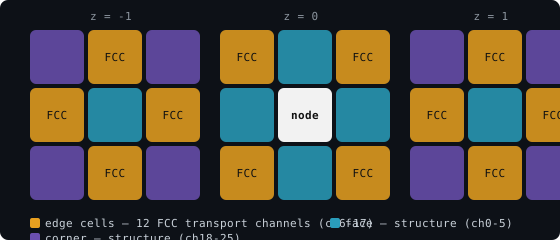
Abstract — The moore26 engine is a discrete cellular automaton that models the quantum vacuum not as an empty coordinate space, but as a dense, strictly conserved thermodynamic medium. Operating on a 26-neighbor Moore grid restricted to an even-parity Face-Centered Cubic (FCC) transport sub-lattice, the engine replaces continuous field equations with local, integer-based causal transactions.
Through closed-box ledger auditing, the substrate conserves energy to 99.999% over 500 ticks: all fractional routing truncations are explicitly booked as thermodynamic entropy (heat) and the sole exit channel is a designed per-node radiation vent (h>>7, 127 units — the physical entropy sink). The remaining ±5-unit residual is register-precision dust: the substrate's intrinsic quantization noise floor.
Within this environment, macroscopic constants are not hardcoded but emerge from structural rate equilibria. The speed of light (v/c = 1.00 hop/tick) emerges from unit transport lag. Quantum bound states — such as the 519-winding dimer — form via a "surplus toll" mechanism, where transient kinetic flux pays a friction cost to travel along established topological rails without eroding the core bond. The engine natively finds a scale-invariant specific density for matter: an intensive mass-to-bond accretion equilibrium of 47:161 (~0.285) across a 4× size range.
The moore26 architecture demonstrates that inertia, binding energy, linear superposition, and the First Law of Thermodynamics can arise from the asymmetric deposition and chained volumetric routing of discrete kinetic flux.
See also: fcc-substrate (geometry), moore26-findings (phenomenology), transaction-ledger (mechanics), and the rules reference.
Reference visualizations
What nature's measured structures look like at the engine's own scale — external MIT Physics visualizations, mapped onto the substrate's concepts:
The proton — spin structure at femtometer scale. The relativistic sea the wound knot is the substrate's candidate for: quark-gluon constituents, spin flips on exchange, counter-propagating orbital flows. The substrate's version: dd imbalance, packetPar parity shed on emission. Transcript + substrate mappings
The nucleus — dynamics at 0.1–3 fm. Nucleons moving ~1/3 c, confined, vibrating — the regime a 0.1 fm node spacing simulates directly. Transcript
The neutrino — beta decay and the parity question. The process whose handedness asymmetry the substrate doesn't reproduce yet — the deviation audit's open P-violation item. Transcript