The FCC substrate — our flavor
moore26 runs on the 26-neighbor Moore grid, but its transport layer is deliberately not cubic: only 12 of the 26 channels carry packets — the face-diagonal FCC edges — and only on the even-parity sublattice. The result is a local causal unit that is geometrically a rhombic dodecahedron, not a cube.
Channel layout
| Registers | Channels | Role |
|---|---|---|
| faces | 0–5 | structure only (no transport) |
| edges | 6–17 | the 12 FCC transport channels |
| corners | 18–25 | structure only |
The 12 transporting directions are the FCC edge vectors — every {±1,±1,0}, {±1,0,±1}, {0,±1,±1} combination:
(1,1,0) (-1,-1,0) (1,-1,0) (-1,1,0)
(1,0,1) (-1,0,-1) (1,0,-1) (-1,0,1)
(0,1,1) (0,-1,-1) (0,1,-1) (0,-1,1)
All 12 have length √2; adjacent directions have dot product 1 (cos 60° = 1/2 — the bend-handoff projection weight).
The parity lock
Transport runs only on even-parity cells ((x+y+z) & 1 == 0). Edge hops preserve parity: a (1,1,0) hop sums to +2, so even cells map to even cells. The odd sublattice is dead space for packets — the vacuum's transport graph is the FCC even-sublattice, not the full cubic grid. Packets arm only on even cells; odd cells still hold winding and structure.
The geometry
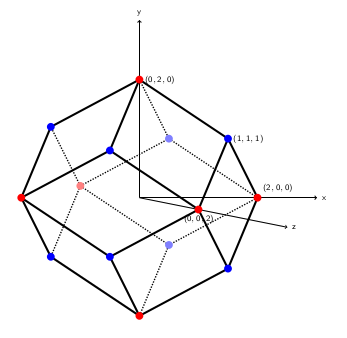
- Voronoi cell: the FCC lattice's Wigner-Seitz cell is the rhombic dodecahedron — 12 rhombic faces, each facing one nearest neighbor = one transport channel. Face-transitive: every channel is symmetry-equivalent (which is why transport is isotropic — the fairness is geometric, not a rule).
- The register map IS the polyhedron:
12 faces + 6 axis vertices + 8 corner vertices = 26channels. The6order-4 vertices (axis positions(±2,0,0)) are the face channelsch0–5; the8order-3 vertices (cube corners(±1,±1,±1)) are the corner channelsch18–25; the12rhombic faces are the transport edgesch6–17. Vertex order explains the asymmetry:4transport faces meet at each axis vertex vs3at each corner —⟨100⟩axes are structurally more congested than⟨111⟩. - Neighbor shell: the 12 nearest neighbors sit at the vertices of a cuboctahedron (the rhombic dodecahedron's dual — an Archimedean solid).
- Symmetry: full octahedral
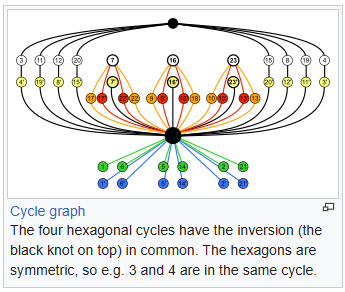
Oh(*432, order 48). The distinguished axes are⟨100⟩and⟨111⟩— the same easy axes real cubic magnets pick. - {111} planes: cross-sections perpendicular to body diagonals are perfect hexagons — the 6-edge ring where two counter-rotating slipstreams coexist (the geometric Pauli pair) and a third is refused.
- Hexagon hop sequence:
ch8,12,16,9,13,15— the six edges⊥(1,1,1), each a60°turn.
Why not cubes?
The plain Moore-26 grid would let packets move on axis (±1,0,0) edges and corners (±1,±1,±1) — unequal hop lengths, anisotropic timing, and the parity check fails. Restricting transport to the 12 √2 edges on one parity sublattice gives a graph where every hop is identical: same length, same tick, same cost. v = 1 hop/tick is isotropic by construction, measured 1.00 on all 12 axes with zero dispersion over nu = 1–255.
The cubic grid is still there underneath — faces and corners hold structure (winding registers live on all 26 channels) — but the causal traffic runs on the FCC skeleton inside it.
Registers per node (392B)
winding[26], packet[26], packetNu[26], packetBorn[26], mass, massFlight[26], charge, chargeFlight[26], incip, incipNu, incipBorn, phase (0–511, currently vestigial — phase_sync kill-switch verified phantom), heat, ack, bondDist, localDensity.
The winding pair split (2e/2e+1) carries direction as dd = a − b imbalance — stored angular momentum, sticky and structural. Slipstreams are dd on a channel; the {111} hexagon hosts exactly two (CW + CCW) = the Pauli pair.