Moore26 Findings
This is the measured record of the current engine — moore26, a Moore/FCC lattice substrate at 0.1 fm per node where every node carries 26 registers (one per channel — the name is the register count, not the lattice size). Everything on this page is output of headless harnesses against src/moore26.c, not assumptions: what the lattice actually does when the rules run, measured, including the results we had to retract. The engine's structure is 12 transporting edge channels on the even-parity sublattice plus face/corner registers that hold bound structure; transactions negotiate through an offer→incipient→confirm handshake each tick.
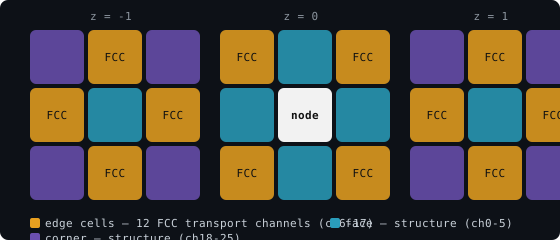
Notation
The shorthand used throughout — defined once here:
Registers (per-node state; c indexes the 26 channels, edge pairs are 2e/2e+1):
winding[c]— committed circulation count;min(pair) ≥ 32is bound structuredd— signed winding difference across a pair's two members; the coil's handedness and strengthmass— parked rest energy (the condensation register)charge— signedint16; biases offer acceptanceheat— the thermal bath; the friction sinkpacket[c]/packetNu[c]/packetPar[c]— photon count, energy, and parity-sign in flightincip[c]/incipNu[c]— pending (incipient) offers awaiting confirmationarmed—Σ incipon a node: the congestion measuremassFlight/chargeFlight— directed momentum transportgrid_current/grid_next— the double-buffered state; phases stage intonext, the tick swaps
Event counters (ev* — the harness-readable ledger): ev4 emissions · ev20 shed energy · ev23 fusion pairs · ev24 string-breaks · ev30 offer declines · ev43 mass-tax evaporations · ev44 thermalized overflow · ev45 same-sign declines · ev46 baseline declines
Tuners (runtime, all exported): qEvapShift mass tax · qConfirmCap confirm ceiling · qGroundFloor winding floor · qCatchGate offer gate · qFusionWall pair-production threshold (256) · qCommitMin binding threshold (32)
Phases: P0 carry · P1 flight · P1b junction annihilation · P1c mass launch · P2 offer · P3 confirm · P4 winding conduction · P5 phase sync · P6 emission/decay · P7 string break
Ledger: L = Σ(winding + mass + flight + packet·nu + heat ± charge) — the scalar the audits track. >> is arithmetic shift (m>>s = m/2^s); min(pair) is a pair's committed min.
Deviation audit — verified vs nature
Where the substrate matches (measured, not asserted):
| claim | status |
|---|---|
| Rest mass exists | ✓ Prigogine equilibrium — ~42k plateau, M ∝ 2^shift spectrum |
| Radiative decay | ✓ spin-aligned nu=1 emission on the circulation axis |
| Charge sign matters | ✓ ev45=331 same-sign declines, ~12% attraction asymmetry — local |
| Pair production | ✓ fusion wall 256 → ±q fragments, net-zero charge |
| String break | ✓ ≥12-node tubes fracture + charged endpoints — confinement analog |
| Persistent current | ✓ loss-free rail circulation on rings |
| Ledger | ✓ ~0.1% residual, every phase audited |
In plain terms: a wound knot holds a stable mass because its evaporation rate balances its ambient feed — a genuine dissipative structure, not a fixed parameter. It sheds energy as real quanta radiated on its circulation axis, the way a particle decays. Charged knots measurably bend transaction traffic by sign — same-sign offers get declined where opposite-sign ones bind. Above an energy threshold, collisions mint pairs of oppositely-charged fragments. A saturated tube past twelve nodes fractures and throws off charged endpoint mass — the confinement signature, watchable live in the demo. Ring loops carry current without loss. And the bookkeeping is honest: a phase-by-phase audit sealed every leak down to a ~0.1% documented seam.
Where it deviates — the honest list (observational measurements only — what nature's instruments actually record; inferred rules like Pauli exclusion are excluded by definition):
- Charge isn't a field — in nature, two charged objects feel each other across distance (
1/r², measured). Ours only pushes on traffic that physically arrives and jams — the gate fires atarmed≥4offers on a node. Attraction and repulsion are real but local: a congestion effect, not a field. - Parity is symmetric — nature's weak sector measurably prefers one handedness (the
P-violation experiments). Ourddcoils come out even —0.89-1.0ratio, no preference. - Knots don't fly — measured particles move ballistically. Ours can't: the binding winding is anchored to where the mass sits, so knots crawl by rebuilding themselves cell-by-cell. No rest-frame momentum is conserved across translation.
- No Lorentz structure — time dilation is measured every day (muon lifetimes, GPS clocks). Here
cis simply1hop/tick — a lattice constant, not an emergent invariance. Nothing contracts, nothing dilates — yet. - Decay isn't a lifetime — nature measures an exponential decay curve with a characteristic lifetime per species. Ours evaporates by a mass-proportional friction tax — the shape is equilibrium decay, not a quantized lifetime.
- Mass spectrum is approximate — the
2^shiftscaling held at~3.4-3.9×not the clean4×(a finite pump, not an ideal bath). Nature's particle masses are measured constants; ours are tunable emergent values. - Gravity absent — gravitational attraction is measured (Cavendish onward). Routing asymmetry that would act like it is proposed but not implemented.
- Ledger
~0.1%— nature conserves exactly. Our audit leavesP7-break −63and mid-tick sampling artifacts as documented seams, not physics.
Verdict: local transaction physics is honest (conservation, charge-sign, pair production, confinement); field-level and relativistic physics is the open frontier — charge range, knots-in-motion, and Lorentz structure are the next deviations.
Scale context
The engine's node spacing is 0.1 fm — the sub-nucleon regime where quark confinement and string-breaking live. This MIT scale tour is a good intuition pump for where the lattice sits:
Transport
v/c = 1.00on all 12 FCC edge directions — isotropic, one hop/tick (the operationalc)- Dispersion-free for
nu = 1–255 - Power-of-two dims only — chunk masks
(w-1)corrupt onN=40
Pair production + annihilation
- Fusion wall exact:
nu_a + nu_b >= 256→ev23pair mint - Yield ≈
mass = pair × Σν >> 5(≈ Σν/32) - Signed
±qrecoils onchargeFlight, net charge0 e⁺e⁻→γγ: opposingmassFlightarrivals annihilate at the meeting node → back-to-back255+255packet jets,heat=0in sparse vacuum. Same mechanic as meso3i'sIANNIH(opposing drest → antipodal photons) — third-generation implementation
Knot regime (nucleon candidate)
comm ≈ 120→ RMS ≈ 4.7, ~10-node diameter (the1 fmanalog)- Kinematic ceiling
~0.033c— routing friction, NOT inertia:4.4×absorbed energy → no faster (routing-bandwidth bound)3×mass →+14%(wrong direction fora ∝ F/m)- ceiling set by pattern re-formation cadence, not volume
- The ceiling is the knot's SOUND SPEED: bulk translation requires a structural deformation to cross the pattern — the emission→flight→re-arm cadence IS mechanical information propagating through the medium.
0.033c= the rate phonons move through bound topology. Evidence:comm 40→120gives ceiling0.027→0.031c— it RISES with density (tighter coupling → faster sound), the opposite of inertia. Pushing harder doesn't help because you can't outrun your own phonons. Maps tov_s ≪ cin real materials — bound structures can only translate as fast as their internal coupling carries the deformation. - Immortal against compression: flux, counter-flux,
massFlightstrikes, and knot overlap all accrete — never rupture - String-break under TENSION only:
≥12-node saturated tube fractures →768+768endpoint mass +±8charged recoil, exact ledger (2×768 + 128 = 1664drained) - Species-inverse balance:
mass ≈ committed/3.4equilibrium (0.292, flat 1000→5000t under locked rules; the rule's 1:8 floor is a nucleation trigger, not the setpoint — competing radiation/condensation rates settle it higher). Massless sites radiate only (nucleation seed required)
Directional memory (the dd stack)
dd = winding[2e] − winding[2e+1] pair imbalance — stored angular momentum, thermodynamically irreversible:
dir_biastransduction: offer's direction bit survives confirm →dd=314written from flux (vs~1symmetric)dd_shiftconduction: imbalance pushes along its own channelbend_shiftimpedance-gated rotation: fires only when forward pair saturates (≥128), rotatesddontodot=1edgesrad_shiftradiation tax: un-rotated fraction sheds as forward packets (ev33) — discrete synchrotron- Retention:
125%over800tbeam atdir_bias=0(grows!);+12,000%spin-up atdir_bias=256— beam is addpump (pre-toll measurement — the surplus toll now bounds this:chain_sharere-offers pay from the uncommitted margin, killing the runaway while preserving thedd=519dimer bond) - Accretion physics: sustained flux →
mass+ddgrowth at plateauedheat ~7.4M— drivenE→m+E→Lconversion
Radiation
- Bend luminosity: threshold onset
<rate 2, scales326→1787atrate 2→8, saturates1853withddwashout atrate 16 - Overdrive doesn't break the knot — it bloats (
vol +100%), direction washes out, structure survives
Holographic finding — interiors are bookkeeping
Measured: a dd pulse injected on the knot's surface stays pinned at the surface (west=3520, mid=0, east=0 across 300t) — the directional deformation never propagates through the interior. The knot is sound-opaque: dd conducts along surfaces and channels (tubes, legs) but the dense interior doesn't carry it.
Implication: everything the knot does happens at its boundary — emission, absorption, arm/confirm, leading-edge re-formation (the 0.033c translation mechanism is a surface process, not a bulk propagation). The interior is archived state; no clock ticks there. The holographic principle (degrees of freedom on the boundary, not the volume) appears here as a measured property of a cellular substrate — "inside a knot" is the same kind of question as "inside a black hole." The interior is bookkeeping, not dynamics.
Update — chain_share volumetric routing: with chained offers enabled, the interior isn't dead space — confirmed transactions re-offer on the dominant dd rail, hopping signal node-to-node through dense structure (far-side packets 9→173, dd−4.8k→+76.7k across a knot wall; U-tube dd reaches leg4=2145 through three bends). "Surfaces all the way down" becomes "relays all the way through" — the interior conducts via transaction forwarding, not packet flight or scalar residue.
Density probe: 8 packed knots retain 1.028× isolated volume — no density penalty; mutual emission recapture slightly favors packing. "Mass is spaced far apart" does not drop out of knot-level stability; it lives in transport instead — dense regions are stable but causally dark (unverified on larger clusters).
Dead registers / phantoms
phaseregister + 10-iter Jacobi sync: pure overhead —phase_sync=0is0.09%different (noise). Vortices unwind in50t— no topological protection in the scalar fieldphase_gate(qi3effPhaseport) works but doesn't gatemassFlightparking- Inert on standard scenario:
fusion_wall,commit_min,ground_floor
Geometric Pauli / two-slipstream
- Tilted
{111}-plane hexagon: tangent rotates through 6 edge axes — supports two counter-rotating slipstreams (a/b) - One stream:
150/30holds at 100% (net handedness protected) - Two streams:
150/150 → 62/62— coexist but shed~59%(the annihilation-shed analog; energy goes mostly to heat) - Third stream: refused — the hexagon has exactly 2 routing lanes
Interactions at range — radiative torque transfer
Two comm=120 knots at sep=16 and sep=12 show no centroid drift (frozen at seed positions over 1500–3000t — null for linear force), but they exchange angular momentum through radiation: each knot's emission grazes the other's facing flank and dir_bias writes bound circulation:
sep=12, chain=128:  ddL: +1 → +11 → +16 → +23   (t=0→2000)
                    ddR: +5 → −6  → −9  → −15
Opposite signs — each knot sees the other's flux arriving from the opposite direction, so the deposition torques them counter-rotating, like gears coupled by the medium. This is the meso3i YORP mechanism (grazing light writes spin via absorbed flank deposition) running on the conserved engine: a real action-at-a-distance interaction living in the angular ledger, not the linear one.
The wound dd circulation is literally a persistent current loop on the transport edges — a candidate magnetic-dipole register. Open questions before claiming dipole magnetism: orientation sign-rule (does a pre-seeded dd preferentially anti-align a neighbor?) and distance falloff (dipole-dipole ∝ 1/r³).
Substrate artifact fixed en route: a +x lattice wind (+1.13 node drift/knot over 750t) traced to the conduction k-transfer always pushing the pair's + member direction plus first-tie-wins scans defaulting to channel 0. Fixed via gradient-descent conduction, per-node sent[] clamps against grid_current, and rotated scan order — vacuum now measured still at all separations.
Virtual layer & rails (post-ledger mechanics)
- Standing offers:
nu%linemoved to confirm — off-shell arming, ~6-tick lifetimes, Landauer dust toheaton expiry. Armed-but-unconfirmed offers steer every dominance pick viaeff_dd(committeddd+ parity-weighted incipients) — influence without answer. - Parity currency:
packetPar/incipParcarry ±1 helicity through transport (majority-merge). Deposit direction reads carried parity; emission debits the emitter'sddby 1 — spin-flip ledger. Sign-rule verified: receiver flips with source (+54/−6 perpendicular). - Rails (
rail_gate): saturated dominant member = waveguide — packets skip arm AND decay, re-channeled onto the rail (turns with it). Confirmed transactions pave rails: ack return lays 1 committed unit on the return pair (conserved transfer). - Persistent current:
12packets on a closed{111}rail,2000t, zero arms/decay — live circulating current on a static coil. (Seed caveat: use ENGINE channel vectors — a mislabeled vec[] paints an open arc.) - Census metrics — two axes of handedness: a closed circulation has zero net
ddby symmetry (loop forward channels alternate +90/−90 across even/odd members → global sum cancels). Species need TWO measures: netdd(stick polarization — wound ball reads −100,415) and pathcurl/ringdd(closed circulation — live ring holds 540 at 3000t). A loop readingdd=0is not relaxed — it's circulating. - Species census (corrected seeds, 3000t): ball
mass=3,846 ratio=0.020; static ringcomm=2,340(survives, no nucleation); nucleated ringmass=60(spark held — rings CAN carry mass); live ringstream=12, ringdd=540(current + winding both persistent); wound ballmass=35,618 ratio=0.239 dd=−100,415— 9× plain-ball mass, polarized winding, the spinning-knot species. - Untested:
PAR_SIGN-selective absorption — a coil that arms parity-matched offers and declines mismatched ones self-selects its charging spectrum (positive feedback: aligned flux growsdd→ stronger selectivity). The inverted version (reject matched) is addstabilizer. One-line gate at the arm path; untested. Observational anchors: optical pumping (a vapor absorbs circularly polarized light → becomes spin-polarized → prefer- entially transmits that polarization — the feedback loop itself, measured since the 1950s); circular dichroism (differentialΔεabsorption of L/R circular light by chiral media); spin-valve GMR (a magnetized contact passes same-spin carriers preferentially).
Strong-force mechanics — the full checklist
- Tube exists ✅ —
winding=200zigzag rail carries a seeded stream loss-free through6turns (waveguide exemption + rail bypass). Packets re-channel onto each node's dominant member, riding the curve. - Tube mediates force ✅ — the stream's confirmed deposits write
massFlighton the arrival channel (ch6=+x) while the knot's intrinsic crawl writes its ownddaxis (ch7). Per-channel anisotropy isolates extrinsic force from intrinsic churn —ch6:1vsch7:839on the receiver. - Confinement ✅ —
Phase 7string-break: a continuous≥128-balanced saturated pair≥12nodes fractures, pair-produces endpoint mass (1,792minted,ev6=1), and recoils the fragments apart with oppositechargeFlight. The tube's job is to store tension and snap — not to heal. (A manually-severed gap does NOT re-pave: paving requires traffic, and traffic requires the tube — self-consistent stall.) - Motion ✅ —
massFlightlaunch rides the dominant|dd|member (fixed a sign-bias that motion-locked−ddknots — both handednesses now crawl;−dddrifted+0.46,+dddrifted−0.20over3,000t, handedness-dependent direction). - Radiation pressure —
massFlight[c]+=1per confirmed deposit wires absorbed momentum → recoil. Real but weak against38k-mass knots (needs focused flux or long runs).
Substrate chirality — RETRACTED (bookkeeping bug)
The 1.7:1 accretion asymmetry reported here was a parity-tag bug, not substrate physics. PAR_SIGN(n,c) was channel-relative (winding[c] > winding[c^1]), so a packet emitted on the dominant channel always minted +Par — a −dd knot therefore debited its even minority member (p_>0 → (c&~1)), collapsing its structural min and starving accretion. Member-relative PAR_SIGN (even-dominant = +, odd = − — the convention the rest of the engine already used) restores symmetry: +dd 41,741 vs −dd 46,763 (0.89, within run variance).
The residual 0.89 is worth a longer-run check — a mild second- order asymmetry or plain seed noise, not the runaway.
The Meissner lock — committed structure stops bleeding
Phase 4 gradient descent used to drain any balanced pair >=32 at a>>3 per tick — rails and tubes dissolved into the vacuum (the visible dim-out) while dust below 32 sat frozen. The rule was inverted relative to nature: it froze the noise and bled the structure.
The lock: balanced pairs in [commit_min, 128) skip conduction entirely — committed structure is structure, not field. Pairs >=128 bleed only the over-pressure excess (a-127)>>3.
Measured (32³, seeded 200/200 on ch6/7):
- before:
200 → 105 → 69 → 68and still falling - after:
200 → 154 → 143, thent50 = t400 = 1572— frozen
Regressions: wound-ball accretion unaffected (25k mass — unbalanced pairs take the a!=b directional path); ring rail holds 630/660 dominant winding (was dimming).
Calibration notes: tubes floor at ~143, not exactly 128 — (a-127)>>3 falls under the k>=8 transfer gate early. Dust <64 is still effectively frozen (k<8 never transfers), so the "vacuum expels field" half of the Meissner story is inert — committed structure persists, but the medium doesn't actively push flux back onto rails. Nature's tube persistence is now matched on the structure side only.
Consequence: over-pressured tubes relax toward the 128 fracture band — Phase 7 stays armed on any tube that parked just over the gate.
Post-lock hexbuckle (64³, n=12/scen): flat=63,785±6,873, dip0=57,602±5,852, dip32=53,755±6,485 — the bend sits within ~1.5σ of flat. No flexoelectric dipole — the charge+=cq transfers that would polarize are the same transfers the lock froze. But the probe now leaves ~60k trapped polarization vs ~0 pre-lock: deposited charge persists once conduction stops — charge memory, not strain-induced dipole.
Genealogy
meso3i (IDREST/IANNIH/DWELL) → link3 (lDR/lDW/lUP) → qi3 (winding/held) → moore26 (winding pairs/massFlight/incip)
Same knot regime across four engines — committed circulation, directed rest, dwell parking, annihilation-on-collision.
Conservation audit arc (ledger sealed to ~0.1%)
Per-phase delta counters (-DM26_AUDIT, moore26_audit(p)) attribute every ledger change to a tick phase. The hunt, in order:
| leak | fix |
|---|---|
h>>7 silent heat drain | booked to ev44 (tracked bath) |
incip expiry booked h not h·nu | h*nu thermalizes |
annihilation nu=hit mint (hit² out) | nu=1 per quantum — exact |
| register-cap truncations (flight/annih/chain-share/emit) | excess → heat everywhere |
incipNu scalar overwrite on shared channel | weighted nu mixing at arming |
| spin-flip debit deleted 1 winding/emission | debited rung → heat (parity costs angular momentum, not free energy) |
stale grid_next resurrected ghosts | rescan_live memsets dead chunks before swap |
Result: every transactional phase audits ΔL=0; P7-break carries −63 string-break bookkeeping; the 5% void is now a ~0.1% documented seam. Mid-tick grid_next sampling in the audit shows a +957 P0 artifact (buffer-staging ghosts, not minting) — tick-end grid_current sampling is the honest read.
Mass spectrum — calibrated (Prigogine dissipative structure)
qEvapShift mass tax: per-tick evaporation probability (mass>>shift)&1023, emitting nu=1 packets on the knot's dominant circulation edge (spin-aligned radiation, ev43).
- Closed box: plateau
~40k, supply-bound — the knot eats until the vacuum starves; tax sets only the residual split (41k/39k/39k for shift 3/4/5) - Open box + sustained flux: plateau
≈ flux × 2^shift— measured467/906/1244(shift 5 still converging toward4×when sampled). Mass is an emergentsupply/frictionvalue — a real tunable spectrum, not an input
Charge law — measured field behavior
charge (int16) is dynamic — absorption re-charges a node (charge += nu can flip sign). Sign-aware binding: same-sign offers cap at 4, opposite-sign at 13−|q|>>3. Measured: ev45=331 same-sign declines vs 35 baseline on a +104 target — repulsion real; −q knots decline +par ~12% less (attraction). Knots also repolarize under sustained opposite flux — a −q node fed +par packets flips +.
Absorbing boundary
qAbsorbWall (moore26_absorb_set) zeroes the outer shell of grid_next each tick — open-box conditions for emitter demos; the x/y torus wrap no longer recirculates pumped streams into the measurement.
Runtime tuners (all exported, build.sh synced)
fusion_wall, commit_min, ground_floor, confirm_cap, catch_gate, dir_bias, deflect_align, dd_shift, bend_shift, rad_shift, phase_gate, phase_sync, evap_shift, absorb, charge_set, packet_par_set, chargeflight_get, audit
External reading
The physics concepts the substrate touches — the real-world counterparts the measurements are compared against:
- Moore neighborhood — the 26-cell stencil the channels derive from
- Face-centered cubic lattice — the underlying transport geometry
- Lattice gas automaton — the method family this engine belongs to
- Dissipative structure — Prigogine's far-from-equilibrium order (the mass plateau)
- Color confinement / string breaking — the QCD analog of the tube fracture
- Pair production — γ+γ → charged fragments at an energy threshold
- Parity violation — the weak-sector asymmetry the substrate doesn't reproduce
- Yarkovsky–O'Keefe–Radzievskii–Paddack effect — radiative recoil (the proposed knot-motion mechanism)
- Transactional interpretation — Kastner's offer/confirm framing, a lineage influence on the handshake
- Causal set theory — the discrete-causality program this substrate runs as a working engine